Case Study 1
Knowing and responding to your student’s diverse needs
Background:
In 2021, UAL claimed itself an ‘activist university’, claiming anti-racism and climate emergency to be central to the student learning experience (Willcocks and Mahon 2023, 187). I was asked to write a new research/ essay unit for BA Photography and decided that, in keeping with UAL’s aims, the unit would focus on ‘Social Justice’ and photographic media. In order to widen participation, the unit invited students to submit either an essay or, the new element of an essay film. Essay films have become synonymous with marginalised groups and activism. The medium provides an inclusive option for students for whom writing presents a particular challenge, offering an option to work with sound and moving image.
Evaluation:
Students initially displayed some reticence at the suggestion of making an essay film as a possibly risky new option. Questions about the form, especially its relation to photography, and how research should be evidenced, were frequent. A ‘frequently asked questions’ section was added to the moodle page to assuage concerns. We continued to feature a wide range of essay films and encourage experimentation within the bounds of the LOs which were highlighted throughout.
On the suggestion of a colleague, for the launch of the unit, I made an essay film to further support and demonstrate use of new methods. A series of technical seminars were booked to support tuition in Adobe Final Cut Pro. To Moodle, I added a repository of further essay films for helpful reference.
Moving Forwards:
According to Wilcocks and Mahon (2023, 195) Bower (2001) has suggested a ‘typology of educational technology tools’ that can be used …to promote more productive and interactive learning. The author ’ highlights ‘text-based’ and multimodal production tools’ such as videos and podcasts to support learning (ibid 196). While Bower was writing for an online cohort, these ideas are applicable more widely in an era of proliferating technological engagement characterised by circulating video.
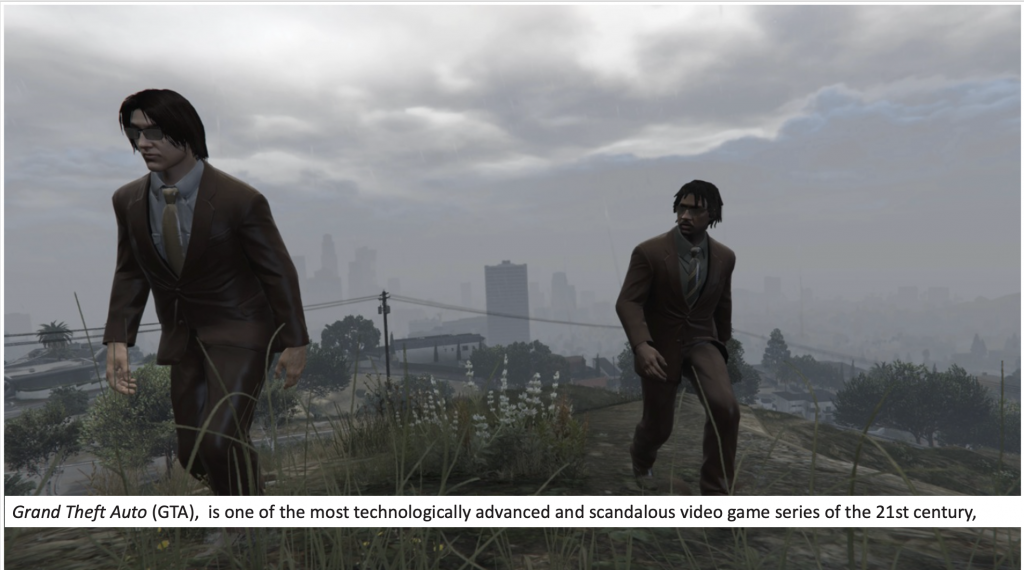
Assigned reading for the unit might comprise essay films and podcasts concerning social justice. For example, Blandy and Archiampong’s (2015) essay film ‘Finding Fanon,’ based on Frantz Fanon’s plays, and made entirely in the Grand Theft Auto V game consul (a form of moving image known as ‘machinima’). The essay functions as a critique of global, digital corporations that economise racial violence in video games, while considering Fanon’s own relation to violence (Krüger 2018). This accessible and inclusive use of gaming media could widen appeal to students reticent about theory and research.
As collaboration is a big part of social justice, another idea to encourage experimentation, could be to ask students to collaborate on a central essay film for the unit, that could be edited by the tutor and launched several weeks before the student hand-in. Students could be asked to donate clips or images on a theme to a central padlet; their names and image references could be added to the final credit list.
(482 words)
References:
Blandy, David and Archiampong (2015) Finding Fanon II available on Vimeo on request.
Krüger, S (2018) Facing Fanon: Examining Neocolonial Aspects in Grand Theft Auto V through the Prism of the Machinima Film Finding Fanon II. Open Library of Humanities, 4 (1):12, pp1-31 https://doi.org/10.16995/olh.177
Wilcocks and Mahon (2023) The potential of Online Object-Based activities to support the Teaching of Intersectional Environmentalism in Art and Design higher education’ Art, Design & Communication in Higher Education, Volume 22 Number 2 www.intellectbooks.com
Case Study 2
Plan and Support Student learning
Background:
Developing a workshop on autoethnography:
This develops in light of case study 1, outlining a further challenge on a new photography unit on social justice. The wildly divergent understandings of ‘social justice’ are interesting, but how best to harness them? Especially as, while some are overtly keen to participate, others feel such issues to be of little concern to them or their photography practice. In short, the term itself can be off-putting in its derisory associations with ‘SJW’s.
Evaluation:
As well as trying to find inclusive materials (see case study 1), I decide to implement a writing workshop on autoethnography in order that students might use their own lived experience of ‘social justice’ as a starting point of orientation, whether this is a direct or indirect experience.
Moving forwards:
Osler et al (2013, 110) claim that ‘Narrative approaches to research offer a semi-structured means of reflection for a researcher in the social sciences’ and the arts. ‘The researcher is at once both subject and object of the inquiry, while a ‘story’, more than the recounting of conventional ‘observations and discussions’, can engage affective and intuitive sensibilities.’
Gallagher (2011: 54) claims ‘the research story as a place to begin inquiry, not a place [in] which to settle meanings’ (ibid 112). The authors refer to the method of ‘literary métissage’ as a strategy for interpreting and critiquing reported experience (ibid 110). While ‘literary métissage’ sounds rather poetic, it may also discourage some students as unnecessarily complex and related to the literary. I prefer the moniker of ‘autoethnography’, which can be embedded into the student lexicon at this early stage, offering a methodological basis for such projects, particularly useful as many students decide to base projects upon personal, often traumatic experience,
Heewon Chang’s book ‘Autoethnography as Method’ (2008) can provide an array of ethnographic samples written in four different writing styles that can be applied to autoethnography: descriptive-realistic, confessional-emotive, analytical-interpretive, and imaginative-creative.’ (n.pag) and will be used to further support the class.
Osler et al deploy metaphors of landscapes and materiality to describe ‘teachers and students’ as ‘co-creators, who can encompass an ecological mindfulness… responsive to [the others] beliefs and actions’ (Davis et al. 2015). (ibid 116) These ecological metaphors may be helpful in moving away from dry, structural concerns toward more creative and poetic ones, helping students who feel that research and essay writing are less creative than studio practice. These metaphors are also helpful in a unit where climate justice is a key concern.
My aim is to use the final seminar in the unit to this end. I intend to deploy some of the insights from this paper and Chang’s book to structure the workshop. (457 words)
References:
Chang, Heewon (2008) Autoethnography as Method New York: Routledge.doi: 10.1386/jwcp.12.1-2.109_1
https://www.taylorfrancis.com/books/mono/10.4324/9781315433370/autoethnography-method-heewon-chang
Osler, trish; Guillard, isabelle; Garcia-fialdini, Arianna and Côté, Sandrine (2019) ‘An a/r/tographic métissage: Storying the self as pedagogic practice’ Journal of Writing in Creative Practice Volume 12 Numbers 1 & 2. Intellect Ltd Article.
doi: 10.1386/jwcp.12.1-2.109_1
Case Study 3
Assessing learning and exchanging feedback
Background:
According to Barrow (2010, 358) an assessment regime utilises disciplinary technologies of ‘hierarchical judgement and supervision’ subjecting students to the normalising gaze of the institution. Higher Education institutions in the UK must adopt Learning Outcomes (LOs) as markers of student achievement, an increased pressure for such systemic conformity is in line with aspects of curriculum design considered ‘constructive alignment’ (Addison, 2014, 314). This is despite LOs being contrary to their anticipated democratising, inclusive aims (ibid 315). For example, LOs can encourage standardisation, homogeneity, micro-management, and close-down critical, esoteric discourse (ibid 316).
2 groups of 8 final year students can choose the research theme and output mode for a final research project (dissertation; essay film; or research publication). I devised an online seminar early in the unit, focussed on developing a working and applied understanding of the LOs and UAL marking scheme in the hope that this applied practice would allow the students to focus on the more personal and creative aspects of their projects.
Evaluation:
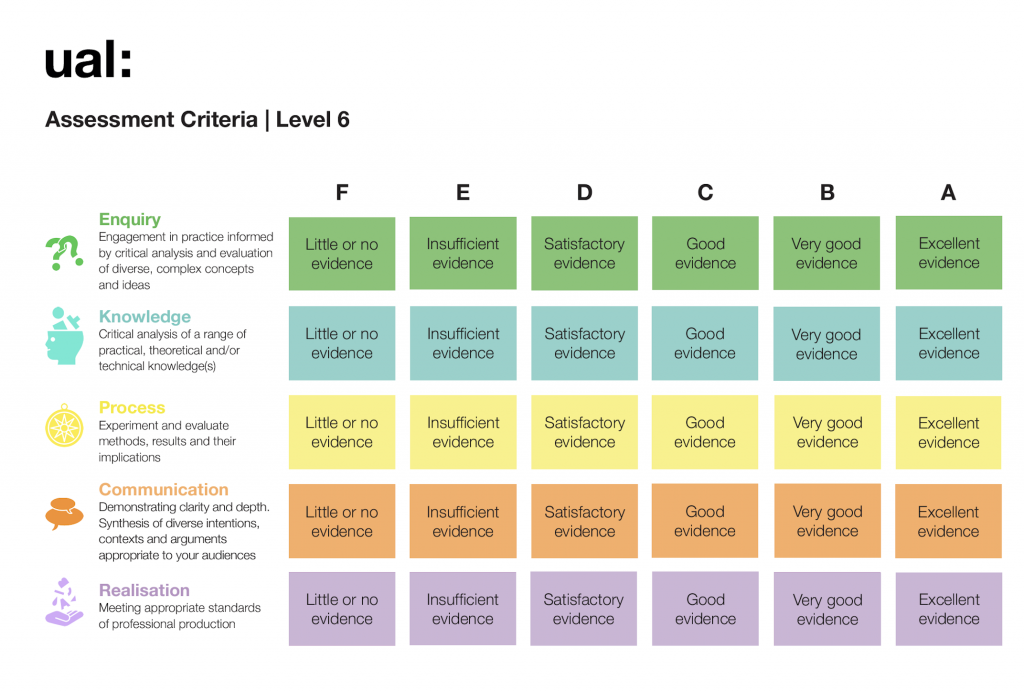
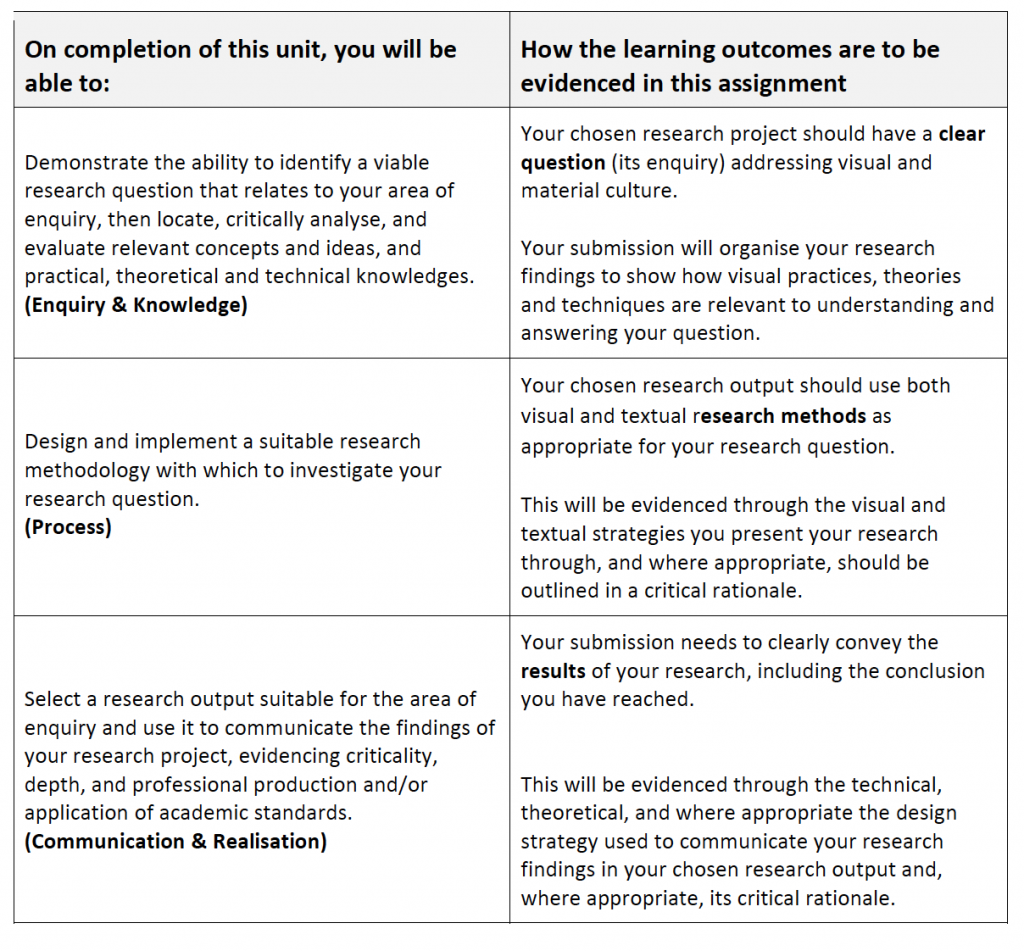
The seminar consisted of the students marking 5 previous year submissions, with final grades from A+- D. I provided students with the UAL marking scheme, which gives the qualities associated with grades (Level 6: A+- Fail. See image 1 below ). We began the seminar looking at the LO’s carefully ( image 2 below) and discussing the evidence required to fulfil them. Students look at the 5 submissions over a period of 50 minutes. As there was not time to read them in detail, we focus on ascertaining whether the submission makes reference to the LO’s (essay question; methods; referencing…) and at what potential quality is given by the UAL marking scheme.
It surprised me how accurately the students could ascertain a grade for the papers.
Moving Forwards:
In the past year, my teaching has been entirely online. One issue with this is that students are reticent about switching cameras on. Despite this fact, students were keen to contribute to the discussion, showing perhaps a willingness to adopt a position usually reserved for the tutor. Reversing a situation whereby the ‘assessment regime(s) may also incite students to confront their self in a way that causes them to establish a link between their intellectual development and their character…’, a self-examination revealed to the gaze of the lecturer or assessor’ (Barrow 2010, 358).
I would advocate implementing this exercise in all contexts, but especially for final year units where there is a high degree of stress and where clarity about LOs and marking criteria can dispel anxiety. Students were positive about the experience, as they were about their own ability to give accurate appraisals using the given information.
(386 words)
References:
Addison, (2014) ‘Doubting Learning Outcomes in Higher Education Contexts: from Performativity towards Emergence and Negotiation’ in iJADE, 33:3. John Wiley and sons.
Barrow, Mark (2006) ‘Assessment and student transformation: linking character and intellect’, Studies in Higher Education, 31: 3, pp.357 — 372
DOI: 10.1080/03075070600680869
Watch, Read, Listen
Join 900+ subscribers
Stay in the loop with everything you need to know.
Leave a Reply