Blog Proposal:
‘Developing an Antifascist Pedagogy‘
I would like to contribute to a series of workshop activity cards produced by Academic Support on the topic of social justice. Developed with input from students/ commissioned artists, they tackle issues of SJ using creative, elliptical tasks for group work. Well received by students in seminars, perhaps because they dealt with difficult issues using clear rules of engagement allowing development of positionality, without the risk of being ‘called out’.
The new activity will be aimed at explicating the ideology of fascism, expanding the egalitarian underpinnings of this unit as part of ‘anti-fascist pedagogy’.
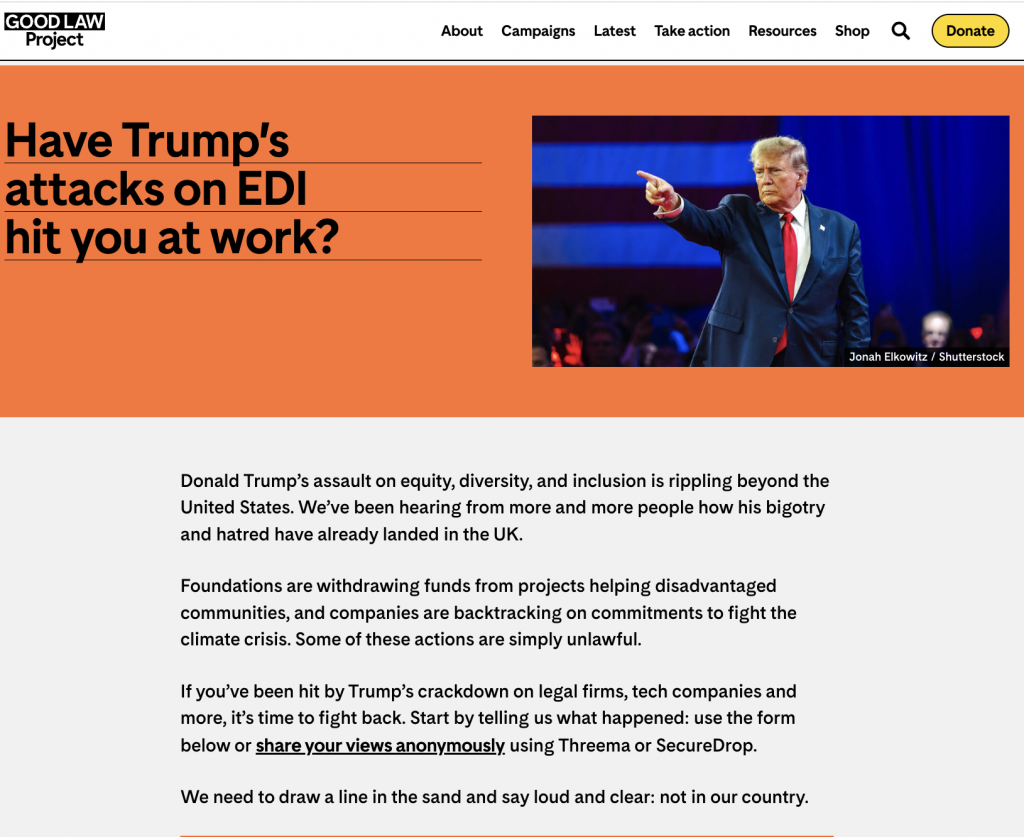
According to Ong et al (2025) UK universities have a pivotal role in responding to Trump’s anti-EDI stance, an attack on safeguarding marginalised groups. Solidarity seems crucial given recent Supreme Court ruling, which insisted sex is ‘determined by biology,’ leaving trans people bereft of protections enshrined in the Equality Act. In a recent article, Cynthia Stark, chair of the University of Utah described the impacts of Trump’s ‘anti-woke’ stance on the university:
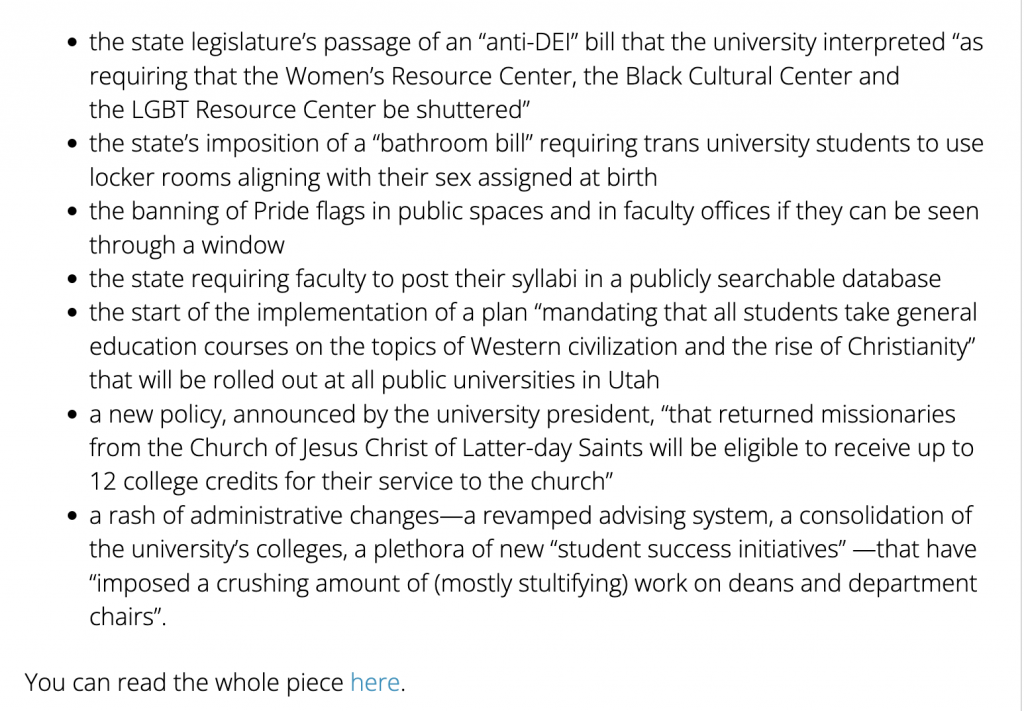
(screenshot from Weinbeg 2025)
The alt-right argues the university is increasingly ‘intolerant’ of ‘traditional values’ (see Weinberg 2025; see Trump 2025). While this may be true, data in this report shows why this is important (see ERI + Hate Crime, below). These proclaimed reversals of ‘intolerance’ reveal the weaponisation EDI and victimisation of the powerful. Ronald Hall refers to the tendency to claim injury whilst occupying power, as ‘entitlement disorder’ (2004).
I want to explicate extremist right-wing propaganda in the material design of recursive social media algorithms (Youtube; Facebook [inc. Instagram]; 4chan, and so on), and reproduction of ‘human’ bias in LLMs [large language models) that encode AI, leading to calls for ‘algorithmic reparations'(Davis; Williams and Yang 2021) Williams (2024) suggests nineteenth century eugenicist narratives are put into play in the guise of technical neutrality (64-67).
Neweth and Scopelliti (2025, 375) claim:
‘…. Far-right actors have… been beneficiaries of ‘the vague [regulatory] policies and the algorithmic clustering of social media content and groups’ which facilitate the ‘distribution of hostile and racist content’.
References:
Buedett, C.; King, A; Newth, G.; Pesarini, A. (2025) Developing Anti Fascist Pedagogies (Workshop ILCS 12 May 2025) IAS UCL London.
Davis L. Jenny; Williams, Apryl; Yang, W. Michael (2021) Algorithmic Reparation in ‘Big Data and Society July- December, DOI: 10.1177/20539517211044808 pp.1-12. Sage [LM1]
Goodlaw Project (nd) Have Trump’s attacks on EDI hit you at work? Available: https://goodlawproject.org/trump-edi-attack/
Hall, R.E. (2004), ‘Entitlement Disorder: The Colonial Traditions of Power as White Male Resistance to Affirmative Action.’ Journal of Black Studies 34:4 Sage. pp. 562-579
Klein, N and Taylor, A. (2025) The Rise of End Times Fascism 13 April 2025 Guardian Available: https://www.theguardian.com/us-news/ng-interactive/2025/apr/13/end-times-fascism-far-right-trump-musk
Neweth, G. and Scopelliti, A. (2025) Common sense, populism, and reactionary politics on Twitter: An analysis of populist far-right common sense narratives between 2008 and 2022. Party Politics 21:2 pp. 375-391. Sage
Ong, Derek, Vytniorgu, Richard and Frank, Kaja (2025) The implications for UK universities of Trump’s attacks on EDI in WonkHE Available: https://wonkhe.com/blogs/the-implications-for-uk-universities-of-trumps-attacks-on-edi/ (accessed 15 June 2025).
Orr, James (2023) Revealed: The Charity Turning Universities Woke. Telegraph Nespaper hosted on YouTube: https://www.youtube.com/watch?v=FRM6vOPTjuU
Trump, Donald J. (2025) Restoring truth and sanity to American history. The White House. Available: https://www.whitehouse.gov/presidential-actions/2025/03/restoring-truth-and-sanity-to-american-history/ (accessed 3 April 2025).
Weinberg, J. (2025) University of Utah cans History and Philosophy Science Major Amidst Political and Administrative Chaos. dailynous.com May 19 2025. Available: https://dailynous.com/2025/05/19/university-of-utah-cans-history-and-philosophy-of-science-major-amidst-political-and-administrative-chaos/
Williams, Apryl (2024) Not My Type: Automating Sexual Racism inOnline Dating. Stanford California: Stanford University Press[LM1]
Report on the Project
‘Antifascist Pedagogy’
In a documentary for the Telegraph James Orr claims that Advance HE and Anthea Swan’s advocacy of training for ‘implicit bias, and anti-racism’ are inappropriate, as universities should be “neutral.” Dr. Vincent Haram claims that evidence of structural racism at the University of Cambridge “does not exist.” Orr claims “we must privilege excellence over ideology”, while ‘woke’ interventions aimed at increasing equity, should be ‘thrown into the river’. What is this supposed ‘neutrality’? What exactly is being ‘thrown in the river’?
Figure 1:
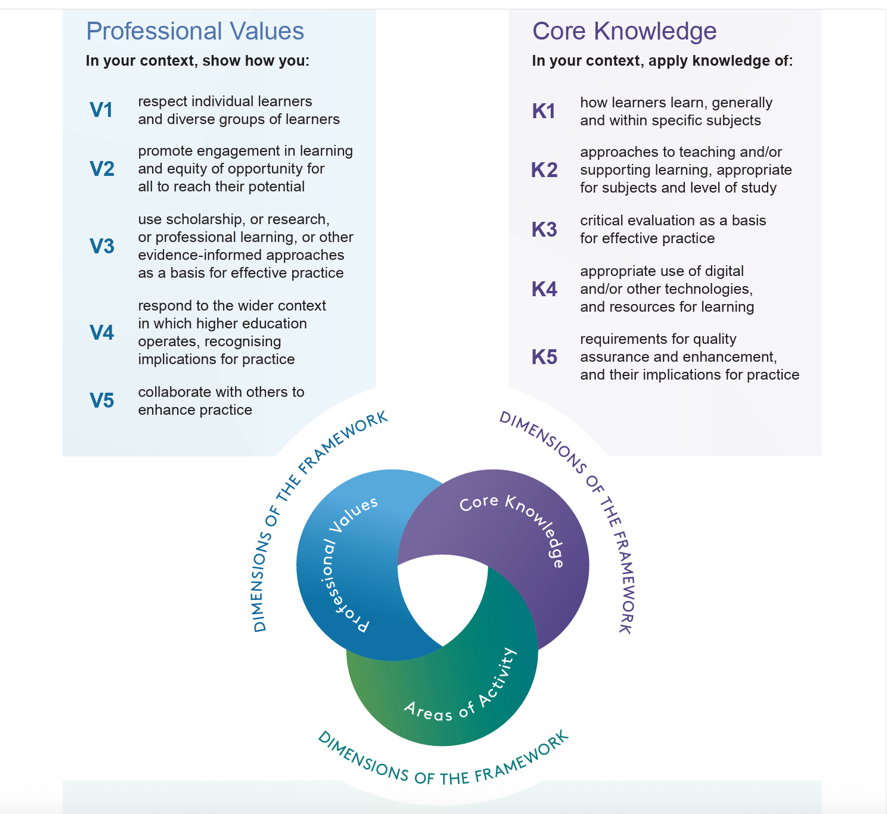
In Advance HE terms, professional values should ‘respect individual learners and diverse groups of learners (V1 fig 1),’ while promoting ‘equity of opportunity for all to reach their potential’ (V2 fig.1).
Like Orr, the alt-right argues that the university is increasingly ‘intolerant’ of ‘traditional values’, by which we understand the wish to consolidate and assert hegemonic characteristics of whiteness and patriarchy (see Weinberg 2025; see Trump 2025). Ideas of the left’s ‘intolerance’ exemplify appeals to already asymmetric power relations, and dismantle affirmative action designed to address historical inequalities (EDI). Right-wing politicians are apt to discuss their positionality as ‘common sense’, meaning self-evident, ‘natural’ and ‘just’ (Neweth and Scopelliti 2025, 375; Pasieska, 2022). The US has shown how rapidly EDI programmes can be dismantled by populist authoritarian leadership. Stirring up suspicion regarding immigration and an image of ‘making America great again,’ (Trump 2025) reduce political complexity and seem to justify doubling down on measures designed to protect vulnerable groups.
While I do not advocate ‘no-platforming’, I would not uncritically welcome political ideologies promoting violence or uncritical eugenics (left or right wing). I have spent my career unpacking the West’s invention of such violent means, and continue.
Tutorial 1: I discussed the possibility of developing a workshop activity card on anti-fascist pedagogy, adding to an existing series of social justice workshop cards developed by Academic Support >Make time to meet with Helena about her SJ cards/ measure impact /Carys’ warns against conflating attendance and engagement in problems around attendance to seminars/ What was it about these cards that leveraged a positive response from students? What is the purpose of the new card, and what evidence might inform it? Caution against “doing something extra, a stand-alone session that is not sustainable”. This worried me: it may well seen that my intervention is ‘extra’. However, it adds to an existing set of workshop prompts. It is also important for my own research and teaching (beyond this course).
Peer Group Feedback:
I spent time speaking with 2 members of my blogging group, during which we listened to, and fed-back on one another’s proposals. This was so very helpful. Phoebe Stringer suggested that fascism is hard to define: how to distinguish between extreme conservatism and fascism? Is it only accidental that the rights of indigenous and working-class people are deemed to be issues of the left? It is notable that today, members of the far- right use narratives of indigeneity to support their own Nationalist, nativist agendas.
Haemin Ho claimed that politics in arts is understood very differently in western/ Asian cultures; the term ‘fascism’ is western-centric, presupposing a level of comprehension that would need to be unpacked. Do we need a different term, neither positive nor negative, to mitigate these cultural differences? Is it reductive to understand such a term within binaries of bad/good?
These were excellent points. For sometime, I worried the project may be overly complex/’additional’ /overly-ambitious… Might it be a question of eugenics rather than the unwieldy political realm of fascism? My colleague’s projects seemed far more precise/ clearly defined/ the required ‘tweak of existing conditions’…
On reflection, there is no ‘good way’ of understanding an ideology predicated upon racism, nationalism and anti-intellectualism (and while fascism may once have advocated for women’s suffrage, it is inherently misogynistic). I would say that my own positionality is inherently ‘anti-fascist’, as is this PGCert course: our unit brief points out that the ‘programme holds the position that racist and ableist structures underpin all institutions,’ indeed, fascism takes these predicates to their extreme, violent conclusion.
However, while I had originally thought that online contexts (social media algorithms and LLMs) would be the focus of this intervention, the excellent feedback from my peer group, tutor made me understand the need to focus on actually explaining what fascism/ anti-fascism are in the first instance! Can we distill its central elements in a way that is useful?
Thus the workshop activity card will aim to explicate the elements of fascism, as part of an ‘anti-fascist pedagogy,’ contributing to the series of workshop activity cards produced by UAL Academic Support on the topic of social justice.
Activity Purpose (1) What is Fascism?
The project will call for clarification of the term and some results of my research will feature here. The word fascist is from the Latin ‘fasces’, a ‘bundle of sticks’ (a collective notoriously hard to break [1]) often shown with an axe head, representing ‘power over life and limb,’ and typically carried by a senior Roman magistrate (Harper 2023). Italian revolutionaries adopted the term in fascio, late 19th century, referring to the shared purpose of militants. Benito Mussolini appropriated the term in a 1919 meeting, to declare war on socialism for opposing nationalism (Paxton 2004, 3-4). Umberto Eco (1995) asks why fascism became a synecdoche for all totalitarianism in the West, particularly as the term seems to have no quintessence? He creates a list of essential indicators of fascism:
- Cult of tradition (learning prescribed by state).
- Rejection of modernism (although technology is worshiped)
- Irrationalism (Thinking as emasculation).
- Anti-criticism (disagreement as treason).
- Fear of difference (racism by definition).
- Appeal to frustration: social groups/ individuals.
- Xenophobia (continually ‘under siege’ by immigrants).
- Lacking objectivity
- Armageddon fixation
- Popular elitism (!)
- Heroic death cult.
- Machismo (phallic power + misogyny).
- No individual rights
- Illegitimacy of parliament.
- Newspeak (after Orwell).
We could possibly add one more category to the list:
- Anti- liberal education: The notion that education breeds dissent, elitism, criticality, and egalitarian values.
For Paxton (2004) fascism is ‘…marked by obsessive preoccupation with community decline, humiliation or victimhood and by compensatory cults of unity, energy and purity, in which a mass-based party of committed nationalist militants, working in uneasy but effective collaboration with traditional elites, abandons democratic liberties and pursues with redemptive violence and without ethical or legal restraints, goals of internal cleansing and external expansion.’ (Paxton, 2004, 218).
Tutorial 2: Consider data that further supports intervention /Hate Crimes/ contact Helena.
Helena Walsh: Helena was happy to meet and discuss the SJ workshop cards she has overseen. She was enthusiastic about potentially including a new addition to her set of workshop cards and had just returned from a conference where the cards were demonstrated as examples of innovative pedagogy. We discussed the playful, creative elements of some prompts, including: designing your own outfit on a theme; creating your own language; brain-storming to develop new art historical terms for excluded groups. She asked me to get in touch if requiring further help or feedback.
ERI and Hate Crime: UK 2023
This section begins to build a basis for my intervention through relevant data which 1. Demonstrates how anti-rascist measures require further work and an understanding of how these very measures can be weaponised against the system that innovates them (as we have begun to see through the Right’s own sense of injury, and notions of ‘neutrality’ promoted by right wing actors and contexts. 2. How violent extremism against marginalised groups has been growing/ attuned to particular social events that propagate renewed attention to these groups. In other words, events that aggravate and expose fascistic qualities.
Ethnic Representation Index:
UAL has created an index that gives a comprehensive perspective on different aspects of Black, Asian and minority ethnic (B.A.M.E.)* including: student journey; staff (academic and professional services); and executive representation. covering 3 categories of outcome. Students and staff of all backgrounds must: ‘1. equally be protected from abuse and discrimination 2. feel a sense of belonging; 3. thrive in their academic work’ (Mba et al 2023).
The latest Ethnic Representation Index report from UAL (2023) claimed that:
Shockingly, ‘…63% of universities in England are less likely to make Black applicants an offer to study when they have the same entry profile as other applicants’ (ibid 20).
In discussing the awarding gap (the difference between White students awarded first-class or 2:1 degrees compared to B.A.M.E students):
‘The B.A.M.E awarding gap was, on average, 12.3% for B.A.M.E students at universities in England. Approximately 65% of universities surveyed had a B.A.M.E awarding gap of over 10% for B.A.M.E students, while 10% of universities had a gap of more than 20%. Only One university had a gap favourable to B.A.M.E students (1.6%).’ (ibid 15)
For Black students, the awarding gap is more extreme, with an ‘average of 19.3%. In England, approximately 75% of universities have an awarding gap of over 10%, with 35% of universities reporting a gap of over 20% and 10% of universities with a gap of more than 30%’(ibid 15)
The average B.A.M.E. representation among academics, professors, senior managers, professional services staff on lower grades, governors, and executives falls short of university student B.A.M.E. representation at all teaching levels.
This information bears out the PG Cert programme’s assertion that ‘institutions are structurally racist’. This information stands in sharp contrast to Jame’s Orr’s dismissiveness of programmes advocating inclusivity and anti-racism, and the claim that ‘the university of Cambridge shows no statistical evidence of rascism (Orr 2023). We also see the ways in which ERI data may inadvertently correspond with aspects of the fascistic qualities indicated by Eco (1995, particularly points 5, 7, 8).
Reported Hate Crimes in the UK:
Hate crime is defined as ‘any criminal offence which is perceived, by the victim or any other person, to be motivated by hostility or prejudice towards someone based on a personal characteristic. There are 5 centrally monitored strands of hate crime: transgender identity; race or ethnicity; religion; sexual orientation; disability (Home office 2024).
Data on ‘hate crimes’ are indicative of wider social intolerance toward so-called minority groups, relevant to this unit, as well as in considering tendencies for violence regarding forms of difference, a central tenet of fascism. We should remember that these data reflect only ‘reported hate crimes to the police’; it is also important to highlight that in 2014, the process underwent a review, after criticism that forces did not consistently understand what constituted ‘hate crime’, therefore, the data does not provide a completely reliable account, but rather shows police time given over to hate crimes (Home office 2024).
It was interesting to note spikes in these crimes, and the associated societal events that serve as their context:
(fig. 2 ) There was a small overall decrease in reported hate crime 2022-2024, but 25% increase in religious hate crime 2024, compared with the previous year. This increase was largely against Jewish community and to a lesser extent Muslims, since the 2023 Israel-Hamas conflict. As in previous years, most hate crimes were racially motivated (70%: 98,799 offences) (Home office 2024).
fig. 2
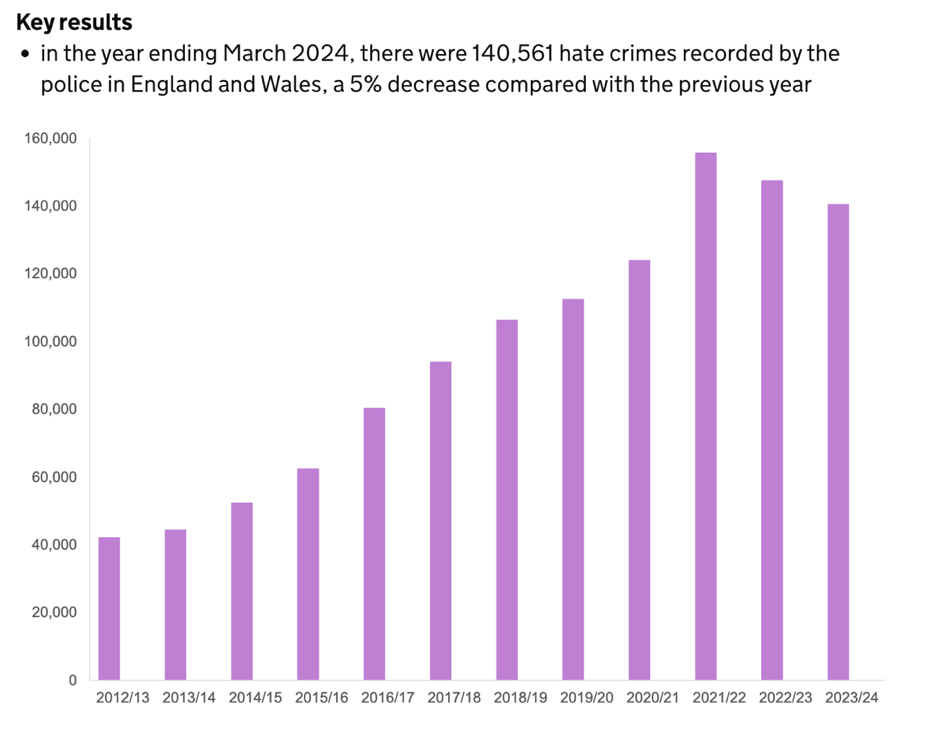
(fig. 3 below) Spikes in racially and religiously aggravated offences:
Depicted spikes reflect the following events: July 2016, the EU Referendum; July 2017, terrorist attacks in London+ Manchester; Summer 2020, Black Lives Matter and far-right counter-protests; and summer 2021 (ibid). According to Stop Hate UK, the 2021 spike intersects with the end of COVID lockdown, showing significant increase in reports related to Gender Identity (55%), Sexual Orientation (41%), Faith (37%) and Disability (43%). (stophateuk.org 2022). Notably, 2021 also saw Trump’s electoral defeat and the storming of the US senate which likely had ramifications globally? The significant leap (in an otherwise fairly steady increase fig 2), between 2021-22, perhaps corresponds with Trump’s valorization of this violent incitement.
Fig. 3
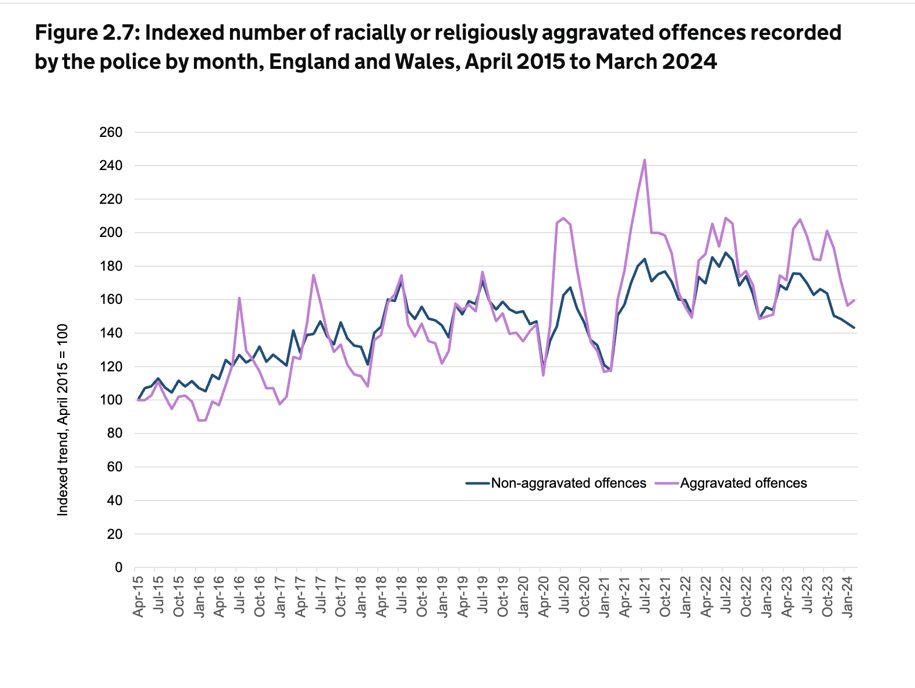
These data sets show how readily fascistic qualities of violence and discrimination are procured and exacerbated across a population. Although data should always be understood as contingent upon underlying factors (for example, the objective of researchers; gaps in data collation; the content of questioning; the selection of respondents, and so on), these samples give us pause to consider some overwhelming issues that confront us today, and warn against complacency.
Notable Resources: construcing the Intervention:
As there is not room to discuss these, I will keep a log of the resources which will be of use in further developing my intervention:
Academic Enhancement Resources UAL
Max Haiven Billionaires and Guillotines: A game designed by the academic anti-capitalist/ anti-fascist author and game designer.
Amy King zine making King’s undergraduate modules explore far-right ideology distribution on social media and internet. Students are introduced to zines as political expression. Citing the conceptual framework of non-hierarchal learning, James Bury and Yoichi Masuzawa identify the importance of ‘empowerment’, ‘student ownership’ and ‘student autonomy and choice’ in the classroom.
The video game ‘Frost Punk’ as discussed in DiTommaso, L. Crossley, J. Lockhart, A., Wagner, R. (2024) End-Game: Apocalyptic Video Games, Contemporary Society and Digital Media Culture. Oldenbourg: De Gruyter
(I am considering developing this research further into a paper on anti-Fascist pedagogy).
Bibliography
Advance HE Professional Standards Framework https://advance-he.ac.uk/knowledge-hub/professional-standards-framework-teaching-and-supporting-learning-higher-education-0
Advance HE Updated Race Equality Charter https://www.advance-he.ac.uk/equality-charters/updated-race-equality-charter
DiTommaso, L. Crossley, J. Lockhart, A., Wagner, R. (2024) End-Game: Apocalyptic Video Games, Contemporary Society and Digital Media Culture. Oldenbourg: De Gruyter
Eco, Umberto (1995) Ur-Fascism Available: https://theanarchistlibrary.org/library/umberto-eco-ur-fascism
Harper, Douglas (2023) Etymology Online https://www.etymonline.com/word/fascist (accessed 26 July 2025)
Home Office (2024) Official Statistics, Hate Crime, England and Wales, year ending March 2024 https://www.gov.uk/government/statistics/hate-crime-england-and-wales-year-ending-march-2024/hate-crime-england-and-wales-year-ending-march-2024
Paxton, Robert O. (2004) The Anatomy of Fascism. London: Penguin
Orr, James
Stop hate UK (2022) Statement in Response to the Publication of the Home Office Hate Crime Data 2021-2022 https://www.stophateuk.org/2022/10/06/home-office-hate-crime-data-2021-2022/)
Haiven, Max (2025) Billionaires and Guillotines Pluto Press, Youtube Available: https://www.youtube.com/watch?v=uAL9BDni8Cw&t=4s
King, Amy (2024) Towards a Creative Anti-Fascist Pedagogy: zine-making in the classroom. Historical Transactions. Royal Historical Society Blog and online resources. Available: https://blog.royalhistsoc.org/2024/08/01/towards-a-creative-antifascist-pedagogy-zine-making-in-the-classroom/#:~:text=Results%20and%20reflections
Mba, David; Bardsley,L.C; Weigel, A; Longville, S. (2023) UAL Ethnic Representation Index 2023 Available: https://www.arts.ac.uk/about-ual/equality-and-diversity/ethnic-representation-index
Neweth, G. and Scopelliti, A. (2025) Common sense, populism, and reactionary politics on Twitter: An analysis of populist far-right common sense narratives between 2008 and 2022. Party Politics 21:2 pp. 375-391. Sage
Trump, Donald J. (2025) Restoring truth and sanity to American history. The White House. Available: https://www.whitehouse.gov/presidential-actions/2025/03/restoring-truth-and-sanity-to-american-history/ (accessed 3 April 2025).
Weinberg, J. (2025) University of Utah cans History and Philosophy Science Major Amidst Political and Administrative Chaos. dailynous.com May 19 2025. Available: https://dailynous.com/2025/05/19/university-of-utah-cans-history-and-philosophy-of-science-major-amidst-political-and-administrative-chaos/
[1] see Paxton 2004